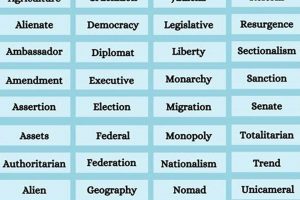
The specific language used within the study of human society and social relationships constitutes a defined lexicon. This lexicon encompasses words and phrases with particular meanings within disciplines such as history, geography, civics, and economics. For instance, the term “checks and balances” refers to a specific system within government, while “latitude and longitude” are precise geographical coordinates.
A robust understanding of this specialized vocabulary facilitates accurate comprehension and effective communication within the social sciences. It provides a common framework for analyzing complex issues, interpreting historical events, and engaging in informed civic discourse. Historically, a command of this language has been essential for both scholarly pursuits and active participation in democratic processes, fostering critical thinking and informed decision-making.
Subsections will elaborate on key concepts, pivotal historical periods, and fundamental principles of governance, employing and defining relevant linguistic components integral to each area. Subsequent sections will explore geographic terminology and economic principles, providing a comprehensive resource for building competence in this crucial domain.
Mastering Social Studies Language
The following points are designed to enhance comprehension and application of specialized language within the field of social studies.
Tip 1: Contextual Learning. Focus on learning terms within the context of specific historical events, geographic locations, or economic systems. For example, understanding the “Roaring Twenties” requires familiarity with terms like “prohibition,” “speakeasy,” and “consumerism.”
Tip 2: Conceptual Mapping. Create visual diagrams that link key terms together within a particular topic. A concept map of the “Cold War” might connect “containment,” “proxy war,” “arms race,” and “mutually assured destruction.”
Tip 3: Active Recall. Regularly test yourself on the definitions and applications of crucial vocabulary. Flashcards, quizzes, and summary writing can be effective methods for reinforcing knowledge.
Tip 4: Primary Source Analysis. Examine historical documents, speeches, and other primary sources to observe the usage of key language in its original context. Analyzing the Federalist Papers provides insight into the language of early American political thought.
Tip 5: Comparative Analysis. Compare and contrast similar terms to discern subtle differences in meaning. For instance, distinguish between “democracy,” “republic,” and “constitutional republic.”
Tip 6: Interdisciplinary Connections. Recognize how terminology from related disciplines, such as economics, political science, and sociology, influences social studies discourse. An understanding of economic indicators like “GDP” and “inflation” enhances historical analysis.
Tip 7: Regular Review. Consistently revisit and reinforce previously learned material to prevent knowledge decay. Schedule regular review sessions, focusing on areas of weakness.
By implementing these strategies, individuals can cultivate a deeper, more nuanced understanding of the complex language underpinning social studies, facilitating more effective learning and application of this subject matter.
The subsequent sections will delve into specific areas within social studies, applying these strategies to further refine comprehension and mastery of the required specific language.
1. Precise Definitions
The foundation of any rigorous examination of human society lies in the accurate and consistent application of its terminology. “Social studies terminology” is rendered meaningless without a commitment to “Precise Definitions”. Ambiguity in defining key terms leads to misinterpretations, flawed analyses, and ultimately, a distorted understanding of complex social phenomena. For instance, the term “revolution” carries a specific connotation within social studies, distinct from its everyday usage. A precise definition clarifies the scale of social, political, or economic upheaval required to qualify as a revolution, differentiating it from mere reform or rebellion. Failing to acknowledge this definitional precision can lead to a mischaracterization of historical events.
The importance of definitional accuracy extends beyond academic discourse, impacting policy decisions and public understanding. Consider the term “democracy”. Its varying interpretations, influenced by cultural and political contexts, necessitate a precise understanding of its core components, such as free and fair elections, protection of minority rights, and the rule of law. Without a standardized definition, discussions about democratic transitions or the health of existing democracies become muddled and unproductive. The adoption of “Precise Definitions” ensures that discussions about societal constructs are grounded in a common understanding, minimizing ambiguity and facilitating constructive dialogue.
In conclusion, the relationship between “Precise Definitions” and “social studies terminology” is symbiotic. One cannot exist effectively without the other. The challenges of applying accurate definitions across diverse contexts and interpretations require ongoing vigilance and critical thinking. However, the pursuit of definitional clarity remains paramount for fostering informed civic engagement and advancing our understanding of the human condition. The ongoing refinement and critical evaluation of the definitions that underpin the social sciences is essential for their continued relevance and intellectual rigor.
2. Contextual Application

The intrinsic value of “social studies terminology” is realized through “Contextual Application.” This means that understanding the meaning of a term is incomplete without comprehending its usage within specific historical, geographical, political, or economic situations. For example, the term “imperialism” denotes the policy of extending a nation’s authority over other territories. However, its understanding is deepened when analyzed within the context of 19th-century European expansion into Africa. Examining the motivations behind imperialism, such as resource acquisition and strategic advantage, reveals the term’s practical significance and the resulting impact on colonized societies. A lack of contextual awareness can lead to a superficial understanding of the term, obscuring its complex interplay with historical events and human agency. Cause and effect become apparent through this contextual lens.
The importance of “Contextual Application” extends to analyzing contemporary issues. Consider the term “globalization.” Its meaning is multifaceted, encompassing economic, cultural, and technological interconnectedness. However, its impact is best understood by examining specific examples, such as the effects of multinational corporations on local economies or the diffusion of cultural trends through social media. A thorough analysis requires considering the perspectives of various stakeholders, including businesses, governments, and individuals, and how “globalization” affects them differently. Understanding “Contextual Application” provides a nuanced perspective on the complexities of current events.
In summary, “Contextual Application” is an indispensable component of “social studies terminology.” It transforms abstract definitions into tangible concepts, enabling a deeper understanding of cause-and-effect relationships and the practical significance of historical and contemporary events. Challenges remain in navigating the complexities of applying terminology across diverse contexts. Still, this approach fosters critical thinking and a more nuanced comprehension of the human experience. Its integration allows more effective use of social studies terminology overall.
3. Conceptual Relationships
A functional understanding of “social studies terminology” necessitates a firm grasp of “Conceptual Relationships.” Individual terms do not exist in isolation; rather, they are intricately linked within a web of interrelated ideas and principles. Comprehending these connections is essential for analyzing complex social, political, and economic phenomena. For example, consider the relationship between “scarcity” and “opportunity cost” in economics. Scarcity, the fundamental limitation of resources, directly leads to the concept of opportunity cost, the value of the next best alternative foregone when a choice is made. Understanding this cause-and-effect relationship is critical for analyzing resource allocation and decision-making processes within economic systems.
The importance of “Conceptual Relationships” as a component of “social studies terminology” is evident in the study of political systems. The concept of “separation of powers,” for instance, is directly linked to the idea of “checks and balances.” The division of governmental authority among different branches (legislative, executive, and judicial) is designed to prevent any one branch from becoming too powerful, thus promoting a balance of power and safeguarding against tyranny. Recognizing this connection is vital for understanding the structure and function of constitutional governments. It also informs our analysis of the successes and failures of political systems in practice.
In summary, the capacity to identify and analyze “Conceptual Relationships” is a prerequisite for mastering “social studies terminology.” It transforms rote memorization of definitions into a deeper, more meaningful understanding of complex societal issues. Challenges arise in discerning the subtle nuances and interdependencies between different concepts, but the ability to navigate these complexities is essential for critical thinking and informed civic engagement. The development of these relational skills remains a core objective for any meaningful engagement with the social sciences.
4. Historical Evolution
The meaning and application of “social studies terminology” are inseparable from the principle of “Historical Evolution.” Words and concepts utilized within the social sciences are not static; their definitions, connotations, and significance shift over time, reflecting changing societal values, new research, and evolving understandings of the human experience. To disregard this historical dimension is to risk applying outdated frameworks to contemporary issues, leading to inaccurate interpretations and ineffective analysis. The term “nation,” for example, has undergone significant transformations. Its meaning during the age of empires differed substantially from its contemporary interpretation, influenced by decolonization, globalization, and shifting notions of sovereignty. Analyzing this evolution is crucial for understanding current geopolitical dynamics and the complexities of national identity.
Understanding the “Historical Evolution” of “social studies terminology” enables a more nuanced comprehension of cause-and-effect relationships in history. The term “capitalism,” for instance, has been subject to varied interpretations and applications across different historical periods and geographical contexts. Analyzing the historical evolution of capitalism, from its mercantilist origins to its contemporary forms, reveals its inherent contradictions, its role in shaping global power dynamics, and its impact on social inequality. This historical perspective is essential for evaluating contemporary economic policies and understanding the challenges of sustainable development. Furthermore, historical analyses of terminology allow us to understand the shifting priorities and evolving understanding of a society, providing critical insights into values and ethics.
In summary, the “Historical Evolution” of “social studies terminology” is an essential component of a comprehensive understanding of the social sciences. It provides a dynamic perspective, revealing how definitions and concepts are shaped by historical forces and, in turn, influence societal development. Recognizing and analyzing these historical shifts is vital for critical thinking, informed decision-making, and responsible citizenship. The challenge lies in navigating the complexities of historical interpretation and avoiding presentism, the application of contemporary values to past events. Yet, the effort to understand the historical evolution of social studies terms remains paramount for fostering intellectual rigor and promoting a more nuanced understanding of the human condition.
5. Disciplinary Integration

The effective utilization of “social studies terminology” depends significantly on “Disciplinary Integration,” the synergistic combination of knowledge and perspectives from various academic disciplines. Social studies inherently draws upon insights from history, geography, economics, political science, sociology, anthropology, and even fields like demography and environmental science. This interdisciplinary approach enables a holistic understanding of complex social issues, mitigating the limitations of isolated, single-discipline perspectives.
- Historical Context and Economic Implications
Economic terminology, such as “inflation” or “GDP,” gains richer meaning when analyzed alongside historical events. Understanding the economic policies implemented during the Great Depression, for example, requires knowledge of both economic principles and the historical circumstances that shaped those policies. Analyzing trade agreements between nations necessitates considering both economic incentives and historical power dynamics.
- Geographic Factors and Political Systems
Political science terminology, such as “federalism” or “democracy,” is significantly influenced by geographic factors. The size, topography, and natural resources of a nation often shape its political structure and governance style. For example, the vastness of the United States has contributed to its federalist system, while resource scarcity can lead to political instability. An understanding of geographic determinism and its limitations enriches the analysis of political systems.
- Sociological Perspectives and Cultural Analysis
The examination of social phenomena necessitates the integration of sociological terminology. Concepts such as “social stratification,” “cultural norms,” and “social mobility” provide frameworks for understanding societal structures and individual behavior. Analyzing demographic shifts, such as urbanization or aging populations, requires understanding sociological theories and empirical data. Analyzing cultural products, from literature to film, demands a comprehension of sociological concepts related to identity, representation, and power.
By embracing “Disciplinary Integration,” social studies scholars and students can move beyond simplistic explanations and gain a more nuanced understanding of the human experience. It facilitates the identification of complex causal relationships, the assessment of diverse perspectives, and the formulation of well-informed policy recommendations. This integrated approach allows social studies terminology to function as a powerful tool for analyzing and interpreting the complexities of the world.
Frequently Asked Questions About Social Studies Terminology
The following section addresses common inquiries regarding the specialized language used within the social studies disciplines. These questions and answers aim to clarify the purpose, significance, and application of this crucial vocabulary.
Question 1: Why is specialized vocabulary necessary within social studies?
A defined lexicon allows for precise communication and minimizes ambiguity when analyzing complex social, political, and economic phenomena. Standardized terminology fosters consistency in research and interpretation.
Question 2: How does mastering vocabulary enhance comprehension in social studies?
A comprehensive understanding of key terms enables students and researchers to accurately interpret historical events, analyze social structures, and engage in informed civic discourse. It serves as a foundation for critical thinking.
Question 3: What strategies are most effective for learning this vocabulary?
Contextual learning, conceptual mapping, active recall, and primary source analysis are proven methods for acquiring and retaining specialized terminology. Consistent review is essential for long-term retention.
Question 4: How does the historical evolution of terms impact their current usage?
The meaning of terms can shift over time, reflecting evolving societal values and new understandings. Recognizing this historical dimension is crucial for avoiding presentism and interpreting events accurately.
Question 5: How does interdisciplinary integration relate to mastering this terminology?
Social studies draws upon concepts from various disciplines, including history, geography, economics, and sociology. Understanding these interdisciplinary connections enriches the comprehension and application of key terms.
Question 6: What are the potential consequences of misinterpreting social studies terminology?
Misinterpretations can lead to flawed analyses, inaccurate historical accounts, and ineffective policy decisions. A lack of terminological precision undermines the integrity of scholarly research and public discourse.
In summary, a thorough understanding of “social studies terminology” is essential for effective engagement with the subject matter. It requires a commitment to definitional accuracy, contextual awareness, and continuous learning.
The next article section will delve into further resources for expanding knowledge and improving the practical application of this essential language.
Conclusion
This article has provided an exposition of “social studies terminology,” emphasizing its pivotal role in comprehending complex societal structures and historical events. It underscored the importance of precise definitions, contextual application, conceptual relationships, historical evolution, and interdisciplinary integration. Each of these components contributes to a more nuanced and accurate understanding of the language used to describe and analyze the human experience.
A continued commitment to mastering this specialized vocabulary is essential for informed civic engagement and effective scholarly pursuit. It is through a rigorous understanding of “social studies terminology” that individuals can critically evaluate information, participate in constructive dialogue, and contribute meaningfully to society’s ongoing efforts to understand itself.